Blood Types and Transfusion

The precise composition of blood and RBC varies between individuals. This difference makes a person’s blood type. Most people use the ABO system to group blood types, as well as rhesus factor, which is either positive or negative.

ABO blood grouping present in a population due to multiple allelism. This blood typing is due to the presence of different sugars that linked to the lipid part of plasma membrane called an antigen.

The antibodies are present in blood plasma. Always a person carry two opposite kind antigen and antibody to prevent blood coagulation. It is also an important step in blood transfusion. Same antigen and antibodies will react and cause agglutination
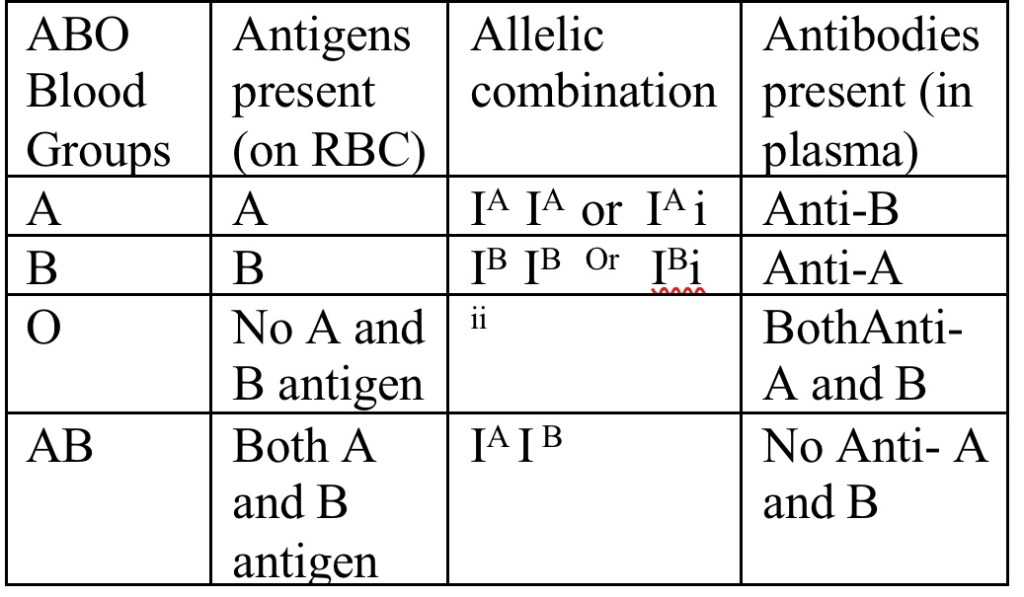
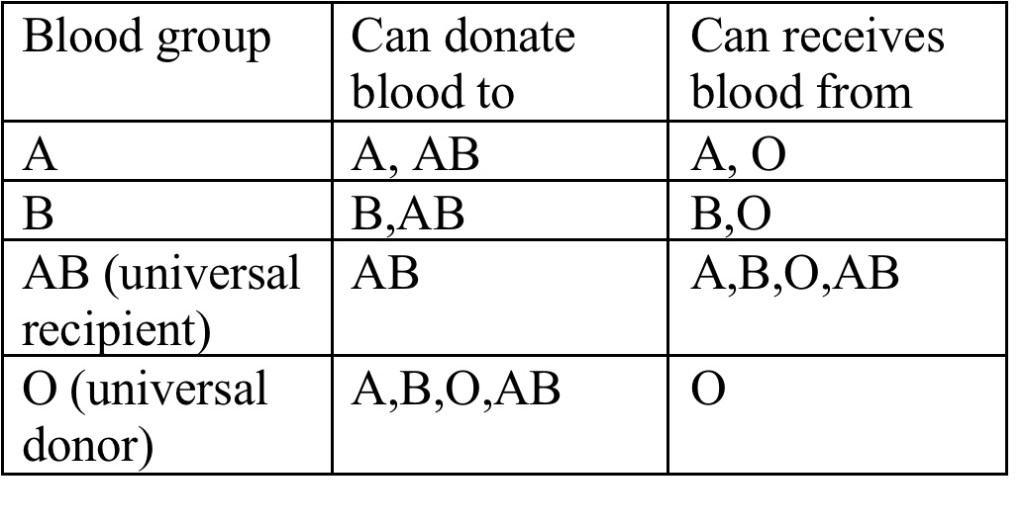
If any foreign cell entered into body, it illicit an immune response. So if person1 with A blood group gives blood to a person 2 with B blood group, the the antigen-A carrying RBC became foreign to the person 2 with B blood group. Foreign antigen A of person 1 will react with anybody A of person 2 and cause agglutination that ultimately cause death of RBCs.

Blood typing is a method to tell what type of blood you have. Blood typing is done so you can safely donate your blood or receive a blood transfusion. It is also done to see if you have a substance called Rh factor on the surface of your red blood cells that we will discuss later.

Table to show who can donate or receive blood for ABO blood grouping system.
Rh Blood grouping

Rh factor it was discovered by Landsteiner and Weiner. Rh factor is an independent antigen present on the RBC irrespective of the presence of Antigen A or B. If this antigen present on RBC, then the person is Rh positive and if this antigen absent on RBC, then the person is known as Rh negative. After the discovery of Rh blood grouping, the ABO and Rh at a time are considered before blood transfusion.


It is explained in the given table:-
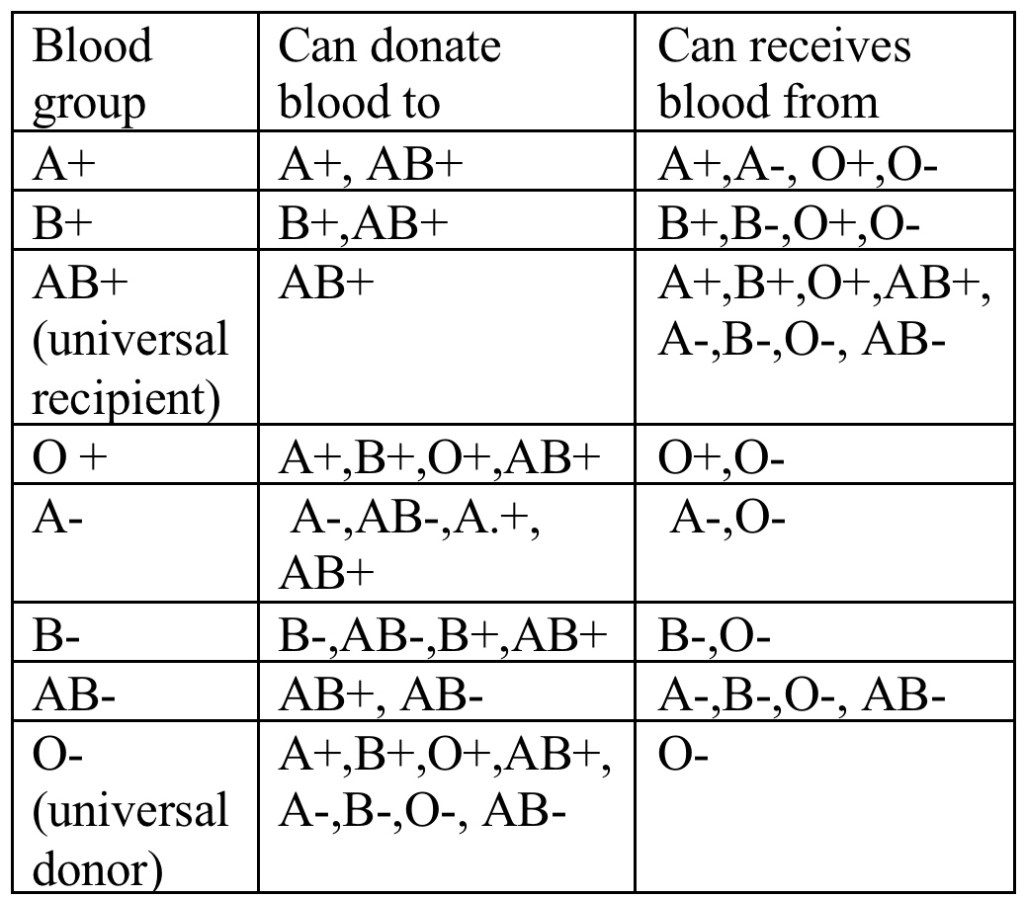
 

If a Rh negative individual gets blood for the first time from Rh positive individual, then it’s immune system produces Ig G type antibody against positive blood which is called Rh sensitisation. Second time if again the Rh negative individual receives blood from Rh positive individual, then the Ig G antibodies present in its blood start destroying the Rh positive RBCs.

The same thing happened when Rh negative mother carry Rh positive foetus for the second time too. If the second foetus is also Rh positive, then the Ig G antibodies (produced during the child birth of 1st Rh positive baby due to mixing of Rh positive blood with mother’s Rh negative blood) present in mothers blood cross placenta and start destroying foetal RBCs. This haemolytic disease is called erythroblastosis fetalis.
Building Blocks Of Nucleic Acids

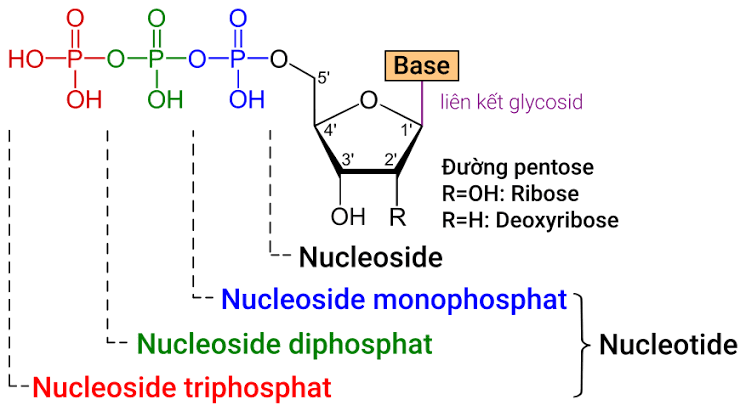
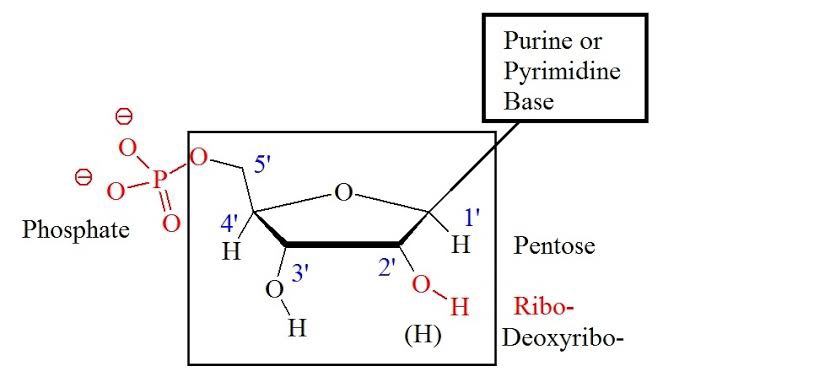
The most fascinating feature of Nucleic acids is self-replication which is not seen in other biomolecules. The monomer of nucleic acid is nucleotide. A nucleotide is made up of the following components:-

  • Pentose sugar
  • Nitrogenous bases Purines
    Pyrimidines
  • Phosphoric acid

Based on the type of pentose sugar present and a difference in a kind of pyrimidine present, nucleotides are of 2 types:-

  • Ribonucleotide
  • 2’ Deoxyribonucleotide

RIBONUCLEOTIDES

1.Ribose Sugar

Molecular Formula:- C5 H10 O5

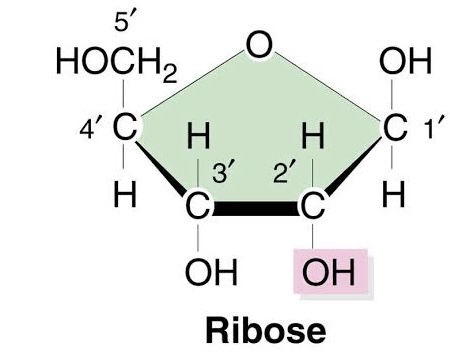
Structural Formula:-


Ribose sugar is a kind of pentose sugar containing 5 carbon atoms. It is present in beta form. In beta ribose, the hydroxyl group of first carbon and the hydroxyl group of 5th carbon are present in CIS form. Both the second and 3rd carbon carry Hydroxyl group.

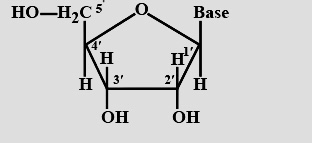
The nitrogenous base is added to the first carbon to produce a a ribonucleoside first. To the 5th carbon, a phosphate group is attached to Produce ribonucleotide.

2.Nitrogenous Bases

A.PURINES

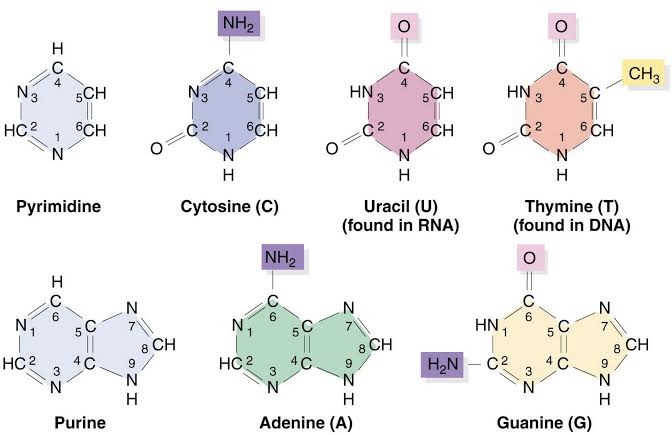
  • Purines are heterocyclic Nitrogen containing aromatic compounds that  consist of 2 rings.
  • 2 types of purines found  in both deoxyribonucleotides and ribonucleotides.
  • They are adenine and guanine.
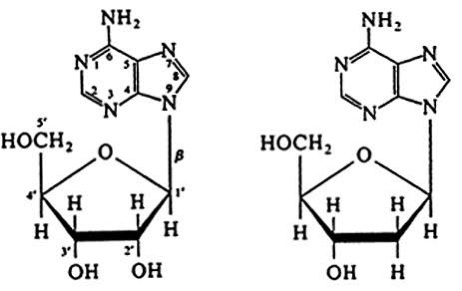
  • Addition of base to first carbon of ribose sugar produces a ribonucleoside.

Ribonucleoside

B.PYRIMIDINES

  • Pyrimidines are heterocyclic Nitrogen containing aromatic compounds that  consist of 1 ring.
  • 2 types of Pyrimidines present in ribonucleotide..
  • They are cytosine and uracil.
  • 3.PHOSPHATE GROUP
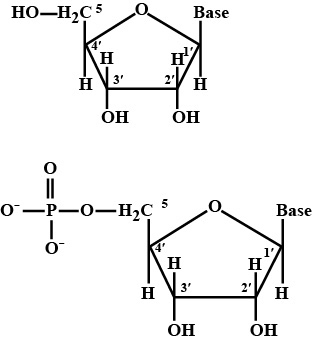
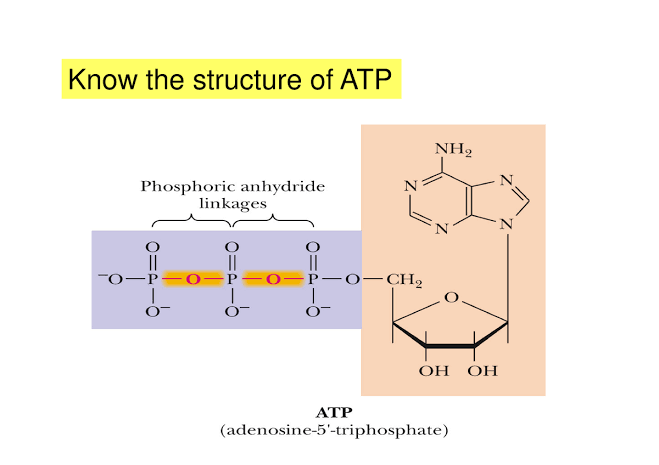
  • When a Phosphate group is attached to the 5’ carbon of ribonucleoside, a ribonucleotide is formed. The bond through which it is joined with the 5’ carbon of ribonucleoside is phosphoester bond.

Addition of one phosphate group to the above ribonucleoside monophosphate produce ribonucleoside diphosphate and one more phosphate group to ribonucleoside diphosphate produces ribonucleoside triphosphate.

Example of ribonucleoside triphosphate

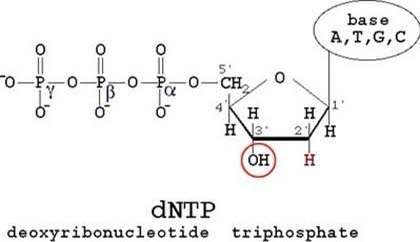
2’-DEOXYRIBONUCLEOTIDES

1.2’-deoxyribose Sugar

Molecular Formula:- C5 H10 O4

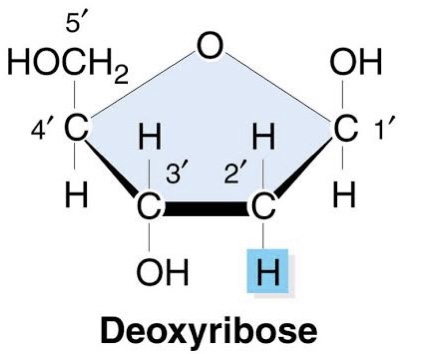
Structural Formula:-


2’-deoxyribose sugar is also a pentose sugar containing 5 carbon atoms like ribose. It is also present in beta form in living organisms.In beta form, the hydroxyl group of first carbon and the hydroxyl group of 5th carbon are present in CIS form. It is called 2’-deoxyribose due to the absence of one oxygen in  the second carbon. It lacks one oxygen as in place of hydroxyl group 2’ carbon carries one -H group. But the 3rd carbon carry Hydroxyl group.

The nitrogenous base is added to the first carbon to produce a a 2’-deoxyribonucleoside first. To the 5th carbon, a phosphate group is attached to Produce  2’-deoxyribonucleotide..

2.Nitrogenous Bases

A.PURINES

  • 2’-DEOXYRIBONUCLEOTIDES also contain the purines, adenine and guanine just like ribonucleotides.
  • Addition of base to first carbon of deoxyribose sugar produces a deoxyribonucleoside.

    B.PYRIMIDINES

  • One of the Pyrimidine present in 2’-DEOXYRIBONUCLEOTIDES is same as that present in ribonucleotides that is cytosine.
  • But the second Pyrimidine present in 2’-DEOXYRIBONUCLEOTIDES is different that is Thymine. A little modification occur in uracil to produce thymine,I.e, addition of one -CH3 / methyl group in 5th carbon. So thymine is also known as 5-methyl uracil.
  • 3. Phosphate Group
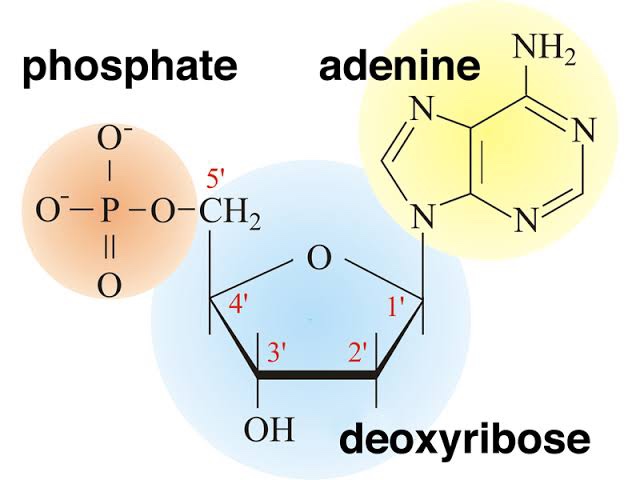
  • When a Phosphate group is attached to the 5’ carbon of 2’-DEOXYRIBONUCLEOSIDE, a 2’-DEOXYRIBONUCLEOTIDES is formed. The bond through which it is joined with the 5’ carbon of 2’-DEOXYRIBONUCLEOTIDES is phosphoester bond.
  • Addition of one phosphate groups to the above 2’-DEOXYRIBONUCLEOSIDE monophosphate produce 2’-DEOXYRIBONUCLEOSIDE diphosphate and one more phosphate to 2’-DEOXYRIBONUCLEOSIDE diphosphate produce 2’-deoxyribonucleoside triphosphate.

Ribonucleotides are building blocks of RNA and 2’-deoxyribonucleotides are building blocks of DNA.

Question :- Why nature select DNA as the genetic material of living organisms but not select RNA?

Design a site like this with WordPress.com
Get started